
What if the most dangerous moment in a cross-chain swap is not the transfer itself, but the approval you barely notice beforehand? DeFi users often describe wallet security as a question of choosing a reputable browser extension, yet the harder problem is understanding what a wallet is actually authorizing. A wallet does not make a smart contract honest, reverse a mistaken transaction, or eliminate the risks created by bridges and liquidity routes. It helps mediate access to blockchain accounts, display transaction information, and request signatures. That distinction is the foundation for using DeFi safely.
For users in the United States considering a Rabby browser extension, the practical question is therefore not simply whether the software is convenient. It is whether the wallet helps the user inspect a transaction before signing, recognize an unfamiliar contract, separate networks correctly, and maintain control of private keys. Recent Rabby messaging has emphasized Ethereum and EVM compatibility across many chains, as well as Chrome and Brave extension access. Those features may reduce friction, but lower friction can also increase the speed at which a user approves a bad transaction. Security depends on the interaction between software, blockchain design, and human judgment.
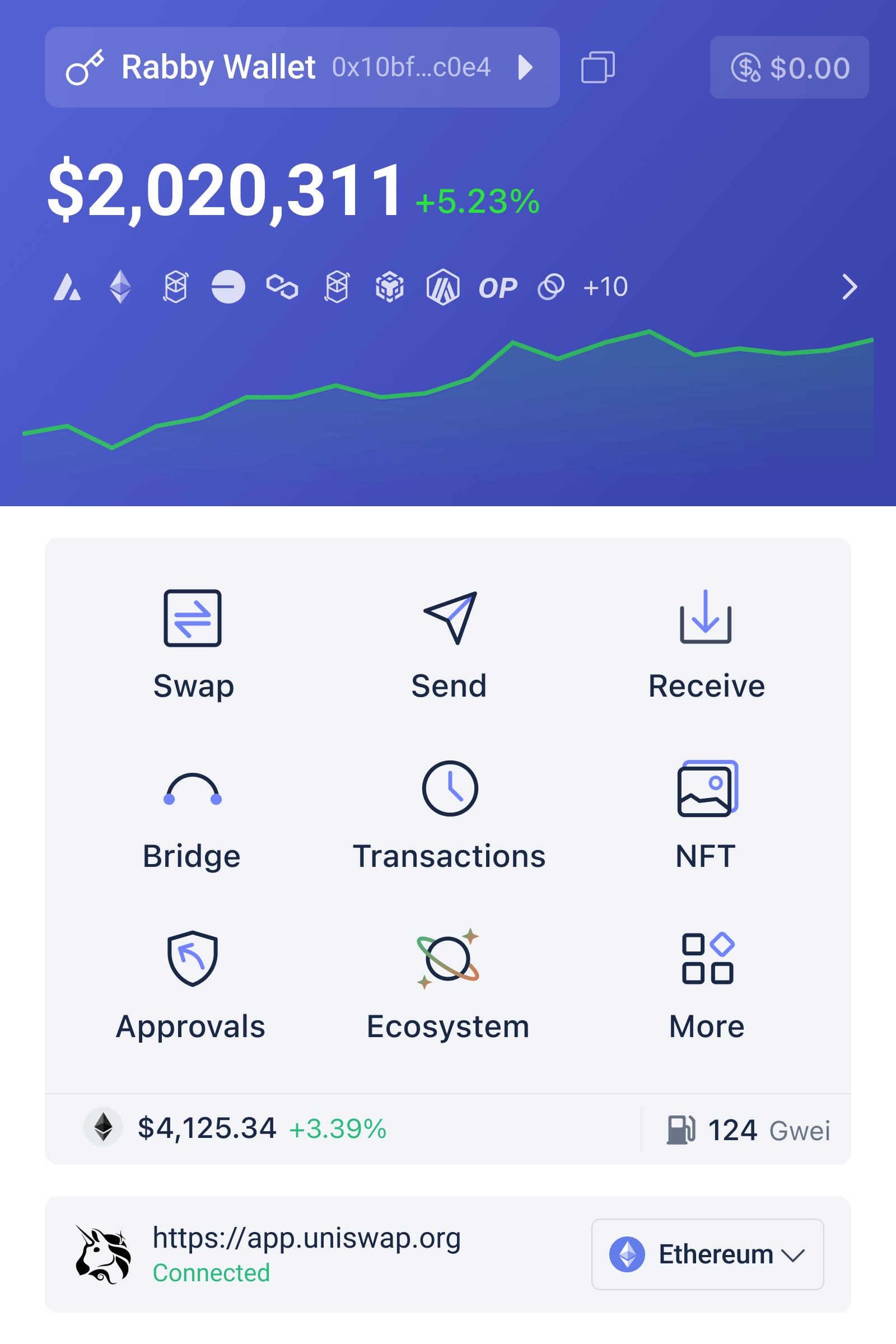
The first misconception: a wallet does not hold the assets in the ordinary sense
A cryptocurrency wallet is better understood as a signing system than as a digital purse. On an EVM-compatible network, the blockchain records balances, token ownership, and contract permissions. The wallet stores or accesses the cryptographic material needed to prove that a user may authorize an action. When a user sends tokens, interacts with a decentralized exchange, or grants an allowance, the wallet signs a message or transaction. The network then evaluates that authorization according to its rules.
This model explains both the power and the limits of a wallet. If a private key or seed phrase is exposed, an attacker may be able to sign transactions without asking the legitimate owner. If a user signs a malicious contract interaction, the blockchain may execute it correctly even though the outcome is harmful. In both cases, the wallet can be functioning as designed. The security failure occurs at the boundary between what the user thought was being approved and what the transaction actually permitted.
That is why a wallet interface matters. Transaction simulation, contract identification, network warnings, and readable summaries can improve the user’s mental model before a signature is made. They are risk-reduction tools, not guarantees. A warning may be incomplete, a contract may change behavior through upgrade mechanisms, and a simulation may not capture every future state of a protocol. The useful question is not “Did the wallet say this was safe?” but “What evidence did the wallet provide, and what uncertainty remains?”
Myth-busting the approval problem
A common misconception is that swapping a token is one atomic action. In practice, many token swaps involve at least two distinct permissions. First, the user may approve a decentralized exchange or router contract to spend a specified amount of a token. Second, the user submits the swap itself. The approval can remain active after the trade is complete, sometimes for a larger amount than the user intended. If the approved contract is later compromised, upgraded improperly, or simply malicious, that standing permission can become a liability.
This is a subtle but important difference between transaction risk and permission risk. A transaction is an event; an allowance can be an ongoing relationship. A careful user should inspect whether an approval is limited to the amount needed, whether the spender is the expected contract, and whether an unlimited allowance is genuinely necessary. Revoking unused approvals can reduce exposure, although revocation itself requires another transaction and does not repair funds already lost.
Wallet security also includes the browser environment. A malicious browser extension, a fake download page, clipboard-replacement malware, or a compromised computer can interfere before the blockchain is ever involved. Users should obtain wallet software through a verified official channel rather than relying on search advertisements or unsolicited messages. For readers who are ready to verify the installation path, the rabby wallet download resource can serve as a starting point, but the installation process should still include checking the publisher, extension permissions, and the wallet’s recovery process.
Why cross-chain swaps create a different security problem
Cross-chain activity is often presented as a simple extension of swapping. It is not. A normal swap usually changes one asset for another within a single chain’s execution environment. A cross-chain swap must coordinate at least two networks, separate states, and a mechanism for moving value or representing a claim on value. The user may interact with a bridge, a liquidity provider, a messaging system, or a combination of these.
Several architectures are possible. A bridge may lock an asset on one chain and mint a representation on another. A liquidity network may pay the user on the destination chain while later settling the provider’s position. A messaging protocol may transmit instructions between chains. Each approach creates different assumptions about validators, relayers, smart contracts, liquidity, finality, and failure recovery. The phrase “cross-chain swap” describes the user experience, not the underlying trust model.
This leads to another misconception: an EVM-compatible chain is not automatically equivalent to Ethereum. Compatibility may mean that contracts use similar programming conventions and that wallets can connect through familiar interfaces. It does not guarantee identical validator assumptions, decentralization, finality behavior, bridge security, fee markets, or contract quality. A wallet that supports many chains makes access easier; it does not make those chains equally secure.
Before approving a cross-chain transaction, a user should identify the source network, destination network, asset being sent, asset expected in return, and mechanism responsible for settlement. The displayed destination token may be a canonical asset, a bridged representation, or a protocol-specific token. That distinction affects liquidity and redemption risk. If a route fails, the user may face delays, manual recovery, partial execution, or an asset that cannot be exchanged at the expected price.
The practical security model: reduce ambiguity before signing
The most reusable decision framework is to treat every DeFi interaction as a sequence of questions rather than a single approval button. First, identify the action: transfer, token approval, swap, staking deposit, bridge deposit, or contract call. Second, identify the authority being granted: a one-time movement, a spending allowance, or a more complex permission. Third, identify the parties involved: the wallet account, the contract, the router, the bridge, and the destination chain.
Fourth, compare the transaction with the user’s intention. Does the amount match? Is the recipient or spender familiar? Is the network correct? Is the expected output plausible after fees and slippage? Fifth, consider reversibility. Most blockchain transactions cannot be undone by a customer-service department, and a successful signature may be final even when the result is economically unfavorable. Finally, ask what remains exposed after completion, particularly allowances and connected applications.
A useful operational separation is to maintain different accounts for different levels of risk. A long-term holding account should not routinely connect to experimental protocols. A trading account can contain only the capital intended for active use. A hardware wallet can add protection for high-value assets, although it does not prevent a user from signing a malicious transaction on the device. This is a boundary condition worth emphasizing: key isolation protects against certain forms of theft, but it cannot replace transaction comprehension.
Security hygiene should include backing up the recovery phrase offline, never entering it into a website, using a strong device password, keeping browser and operating-system software updated, and verifying addresses through more than one channel when the amount is significant. In the United States, users should also be cautious about tax and recordkeeping consequences. Cross-chain movements and swaps can create reporting complexity even when the security outcome is sound. A secure transaction is not necessarily a simple transaction from an accounting or compliance perspective.
Where wallet warnings help—and where they break
Readable transaction simulation is valuable because raw calldata is difficult for most people to interpret. A simulation can show expected balance changes, token movements, and potential warnings before a signature. Yet simulations are conditional forecasts. They depend on the current state of the chain, the behavior exposed during the simulated call, and the assumptions built into the analysis system. State can change between simulation and inclusion, especially in active markets.
There are also risks that interfaces cannot fully solve. A legitimate-looking token may have restrictive transfer logic. A protocol may be governed by an upgradeable contract whose future implementation differs from the current one. A bridge may be technically correct but economically fragile if its liquidity disappears. A contract address copied from a message may be genuine while the requested function is not what the user intended. Better design reduces cognitive load, but reducing cognitive load can sometimes conceal complexity that deserves attention.
The right stance is neither blind trust nor total distrust. Treat wallet warnings as one layer in a defense system. Combine them with a verified application domain, a known contract address, limited approvals, small test transactions, independent review of the route, and an account structure appropriate to the amount at risk. The more irreversible the action, the less acceptable it is to rely on a single signal.
What to watch as EVM access expands
Rabby’s recent positioning around broad Ethereum and EVM-chain access suggests a continuing direction in wallet design: one interface connecting users to more networks and applications. If that direction continues, the central security challenge will shift from basic connectivity to meaningful comparison. Users will need to distinguish not only among tokens, but among settlement assumptions, bridge dependencies, fee structures, and contract permissions.
That future is conditional. Better wallet interfaces could make these differences more visible, particularly if they explain destination risk and persistent approvals in plain language. Conversely, if multi-chain access becomes mainly a convenience layer, users may approve routes they do not understand because the interface makes them appear uniform. The signal worth watching is not the number of supported chains alone. It is whether the software helps users understand what changes when an action crosses a network boundary.
Frequently Asked Questions
Is installing a browser wallet enough to secure DeFi funds?
No. Installation is only the beginning. Security also depends on how the recovery phrase is protected, whether the computer and browser are trustworthy, which applications are connected, what permissions are granted, and whether transactions are reviewed before signing. A wallet can improve visibility without guaranteeing the behavior of a smart contract or bridge.
Are cross-chain swaps inherently unsafe?
Not inherently, but they introduce additional dependencies. The user must evaluate both the source and destination networks, the bridge or liquidity mechanism, the asset representation, and the route’s failure conditions. A cross-chain transaction may be reasonable when those assumptions are understood and the amount is proportionate to the risk; it is not made safe merely because the interface resembles a familiar swap.
Should users approve unlimited token allowances?
Unlimited allowances are convenient because they avoid repeated approval transactions, but they create a broader standing permission. A limited approval may reduce potential exposure, especially when interacting with unfamiliar or experimental protocols. The trade-off is additional transactions and fees. Users should review allowances periodically and revoke permissions they no longer need, while remembering that revocation cannot recover already stolen assets.
The sharpest mental model is simple: a wallet is not a safety certificate; it is a control panel for irreversible authority. The quality of that control panel matters, especially when users move across EVM chains, but the decisive security habit remains the same. Before signing, identify what permission is being granted, which system will execute it, and what could happen if that system fails. In DeFi, clarity is not an accessory to convenience. It is part of the security mechanism.